top of page


THE TEXTS*:
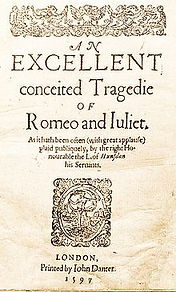
SHAKESPEARE'S ROMEO & JULIET
— published 1597

BAZ LURHMANN'S ROMEO & JULIET
— debuted 1996

TAYLOR SWIFT'S "LOVE STORY"
— 2009

JONATHAN LEVINE'S WARM BODIES
— 2013

HALSEY'S "NOW OR NEVER"
— 2017
*(MELO)DRAMA: MODERN VERSIONS OF R&J
please click on each selection of white text to be taken to each page!
Each of these texts plays a vital role in our understanding of why Shakespeare's tale of Romeo & Juliet is so prolific, and still so applicable to how the trope of star-crossed lovers is so alluring within the genre of teenage romance. The four additional texts chosen show a modern, remixed version of the classic Romeo & Juliet tale, and each portray how inherent the characters' adolescence feeds into the allure of the star-crossed lovers trope. The original Romeo & Juliet sets the scene in our fair Verona, encapsulating Shakespeare's vision as he saw it.
Baz Luhrmann's Romeo & Juliet is a modernized retelling, placing our familiar feud between the Capulets and Montagues in Verona Beach, California, where each family belongs to a life of crime. While the original Shakespearian dialogue is used in this version, Luhrmann gives the audience a snazzy update with modern features of the 90s and gang violence, an attempt to showcase how transcendent the narrative of a fated love still is. Using familiar faces of Leonardo DiCaprio and Claire Danes, Luhrmann showcases heartbreak through heartthrobs.
Romeo and Juliet through Taylor Swift's "Love Story" is still very true to the original plot, but modernized in her speaker and her lover, who go through trials and tribulations for their love at the hands of their feuding families. In the music video, the audience sees snippets of her speaker in a modern, 2000s-era college setting, but as the music swells and the lyrics "we were both young when I first saw you" start playing, the scene transforms to Swift-as-Juliet, seemingly eschewing the modernity from the beginning of the video and settling us back in the past. We get taken through forests and fields, castles and magic, painting a much more whimsical version of our original fated tale.
In another version, the movie Warm Bodies is a hyper-modern, post-apocalyptic narrative in which the main character, R, is a zombie who prattles through an abandoned airport, unable to remember his life as a human. Once R meets Julie, who is still human, he can feel his heart beating again for the first time in years. R, fascinated with Julie, takes her hostage after killing her boyfriend and covering her with blood to mask her human scent. Julie, while initially terrified with R, slowly comes around to him as they share the space, listening to music, playing games, and talking. Eventually, R becomes more and more human through the bond he has with Julie, but when he attempts to take her back to the human enclave, the two are shown face-to-face that their love between human and zombie is forbidden. This example of the narrative ultimately has a happy ending, adding a twist on the doomed love story that Shakespeare has created.
Finally, in another musical example, "Now or Never" from Halsey's Romeo & Juliet inspired concept album Hopeless Fountain Kingdom, showcases a hybrid post-apocalyptic crime family melodrama. In the video, her character Luna Aureum is a feminized version of Romeo Montague, hailing from the darker and more dangerous part of the city overrun by gun violence and blood feuds. Her lover, Solis Angelus, is a masculinized Juliet Capulet, who unfortunately gets caught in the crossfire between both families once they discover Luna and Solis' forbidden relationship. At the end, we see Luna cutting off her long blue hair, staring straight into the mirror, and the swelling of music signifies that her narrative will continue in other songs of the album after her initial setup as the sole survivor of a pair of star-crossed lovers, inciting hope that the story—if not the lovers—must still go on.
bottom of page